
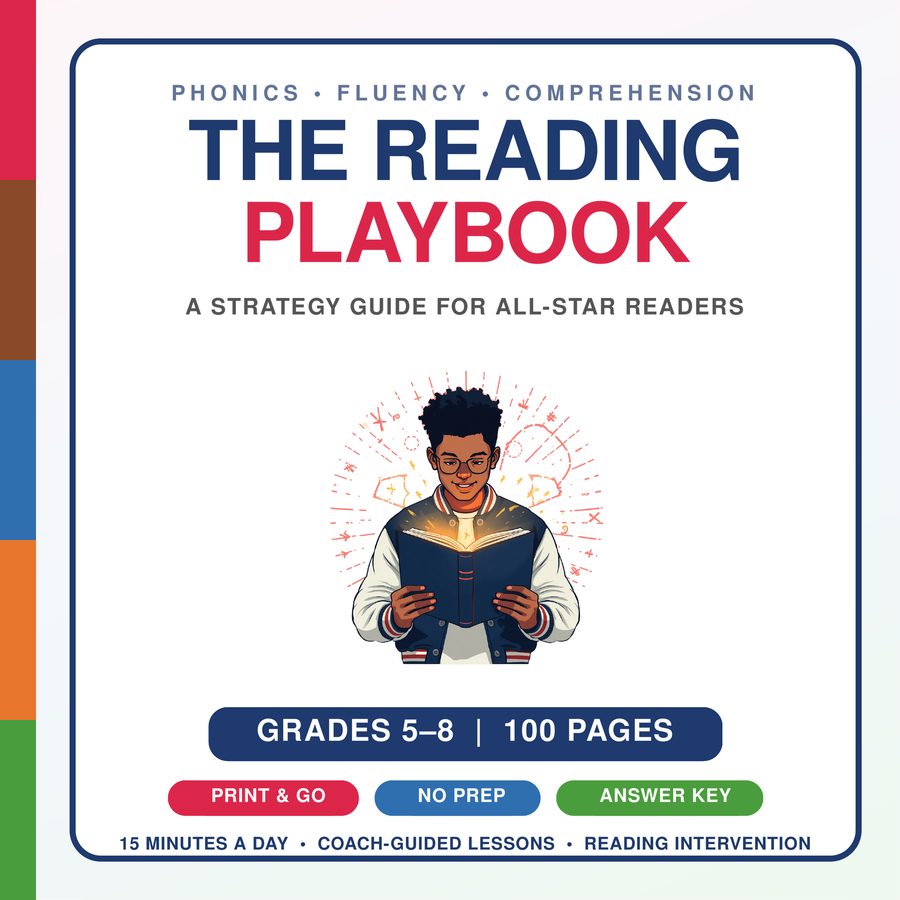
Grades 3–8 • 100 Pages • Instant PDF
Reading help that doesn’t feel like third grade.
Your student can sound out the words. They still stall on transportation, read like a robot, and forget the paragraph the moment they finish it. The Reading Playbook rebuilds those skills in 15 minutes a day — without handing a middle schooler a worksheet covered in cartoon animals.
Secure checkout through Stripe. You’ll land on a download page as soon as payment goes through. Digital download — all sales final.
The gap nobody caught in third grade
After third grade, reading instruction mostly stops. Students are expected to read to learn — and the ones still missing foundational skills quietly fall further behind every year. You may recognize some of this:
- They guess at longer words instead of breaking them apart.
- They read word-by-word, flat and slow, with no expression.
- They finish a page and can’t tell you what happened in it.
- They’ve started avoiding reading altogether — and calling themselves “bad at it.”
- Every intervention workbook you’ve found is written for a six-year-old.
None of that means your student can’t read. It means nobody ever taught them the system underneath the words.
Five sections. One hundred pages. Nothing left out.
Each section is built around a sport, and each builds on the one before it — diagnostics first, application last.
Cracking the Code
Advanced phonics for older readers: vowel teams, r-controlled vowels, consonant-le, and the six syllable types (CLOVER) that make multisyllabic words decodable instead of intimidating.
Pages 7–28Word Power
Morphology. Prefixes, suffixes, and Greek and Latin roots — spect, struct, port, dict — so one root unlocks a dozen words your student has never seen.
Pages 29–48Smooth Sailing
Fluency and prosody. Phrase-cued reading, six repeated-reading passages with cold / second / hot read tracking and words-per-minute charts, plus two Readers’ Theater scripts.
Pages 49–68Thinking Deeply
Comprehension strategies made concrete: visualizing, main idea versus detail, inferencing from text clues, and summarizing with SWBST and the 5 Ws.
Pages 69–88Application
Capstone passages that pull every skill together, a glossary of reading terms for you and your student, the complete answer key, and a certificate worth framing.
Pages 89–100Built-In Supports
A diagnostic pre-test to find the starting line, progress trackers on every page, reflection prompts, and bonus reps — Odd One Out, Find the Mistake, Real-or-Nonsense.
Throughout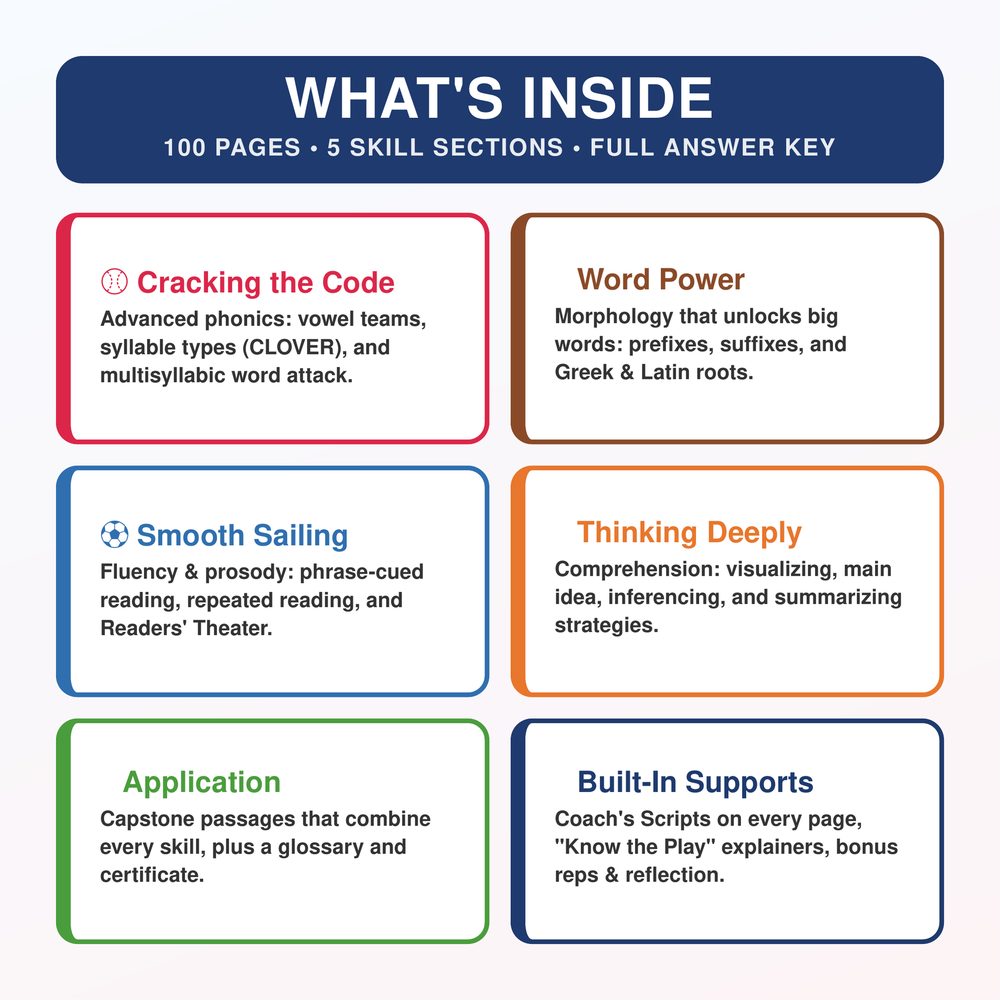
You don’t need a reading degree to teach this
Most workbooks hand you a page and wish you luck. Every instructional page in the Playbook carries a Coach’s Script — the actual words to say to introduce the skill — and a Know the Play box explaining the concept in plain language before your student ever picks up a pencil.
The coaching method is simple enough to hold in your head: Pause, Prompt, Praise. Wait. Give the smallest hint that works. Name what they did right. Fifteen minutes a day, four steps — warm-up, teach, practice, reflect.
The student side speaks in a different voice. They’re the All-Star. You’re the coach. For a twelve-year-old who has spent years being remediated, that framing does real work.
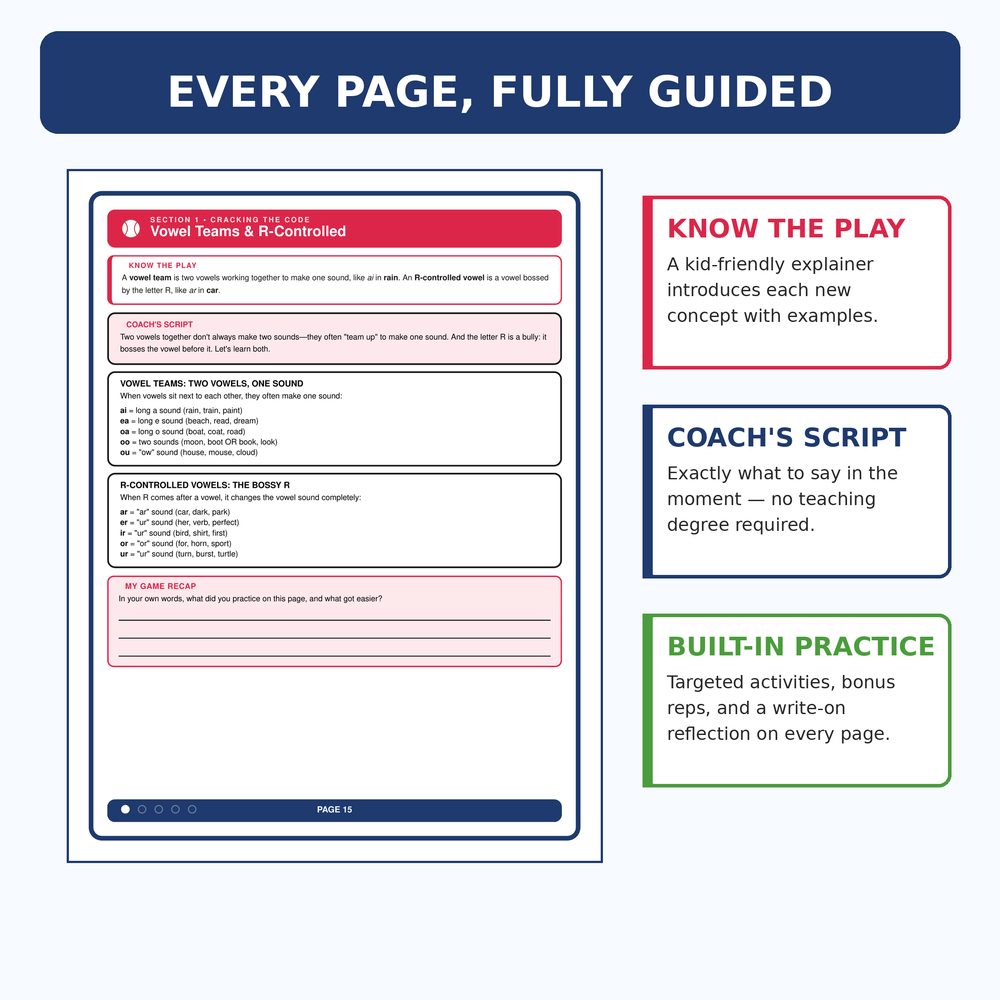
Every page: Know the Play, then Coach’s Script, then practice.
A real page, not a mockup
The six syllable types, taught the way a coach would teach a play.
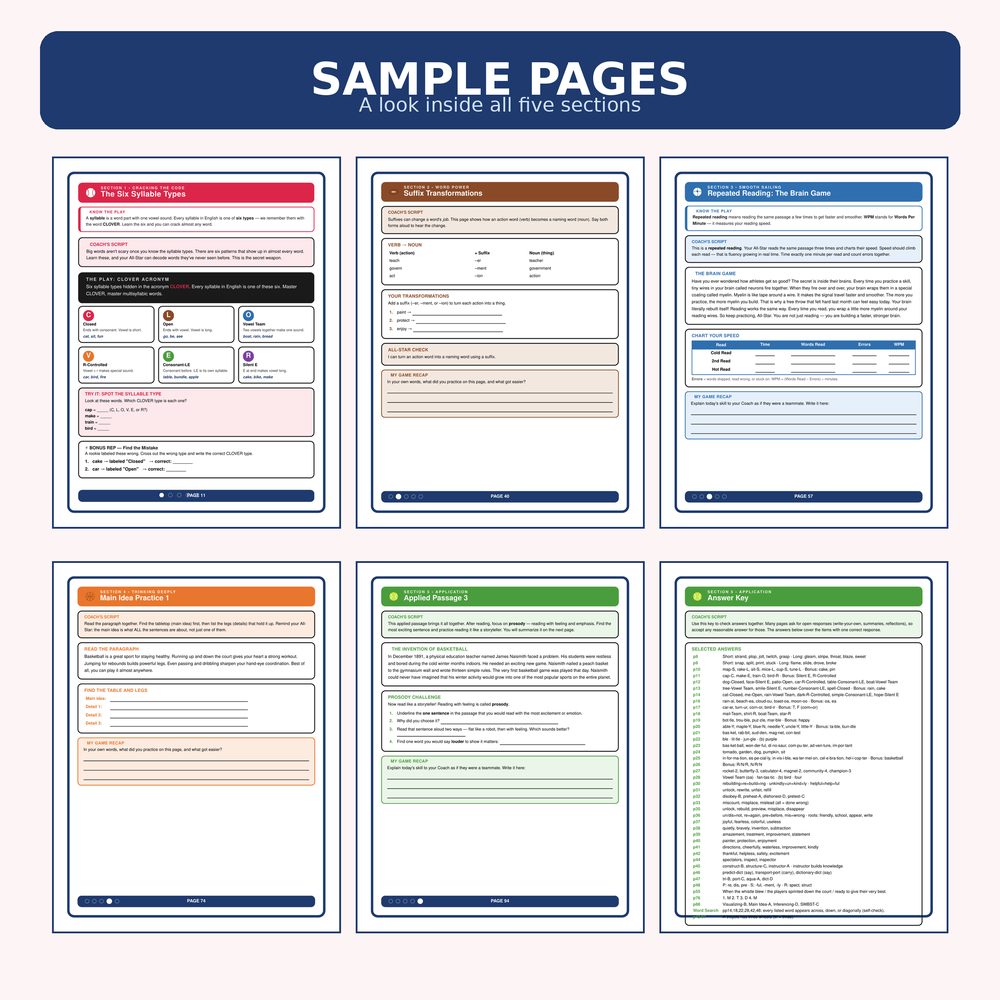
Print-ready on US Letter. Designed to photocopy cleanly in black and white.
Is this the right book for your student?
It won’t suit everyone, and I’d rather tell you now.
A good fit if…
- Your student is in grades 3–8 and reading below grade level.
- They stumble on long words and read without expression.
- You want structured-literacy instruction you can actually deliver at the kitchen table.
- You’re homeschooling, tutoring, or running Tier 2 / Tier 3 intervention.
- You have fifteen minutes a day and a printer.
Probably not if…
- Your child is a beginning reader still learning letter sounds — this starts past that.
- You want a self-paced app. This is paper, and it needs an adult beside it.
- You’re looking for a formal diagnosis. A dyslexia evaluation is a job for a specialist.
- You want something done to your student rather than with them.

Who wrote this
I’m David Lane. I’ve spent more than twenty years in classrooms, hold a Master’s in Educational Leadership and TESOL certification, and I homeschool my own teenager — which is where most of this book actually comes from.
I built the Playbook because I kept looking for an intervention resource for older students and kept finding material designed for kindergarteners. A struggling seventh grader knows exactly what a cartoon worksheet means. It means you think I’m a baby. They shut down, and the reading gap gets wider.
So this one is built on structured-literacy principles — the same systematic phonics, fluency, and comprehension progression the science of reading points to — and dressed as a sports playbook, because a kid who has failed at reading can still be an athlete learning a system.
Questions
How do I get the book after I pay?
Checkout runs through Stripe. As soon as your payment clears, you’re taken to a download page for the PDF. Nothing ships; nothing arrives in the post.
Do I have to print all 100 pages?
No. The book is designed to be worked in order, but each page stands alone — print a section at a time, or only the pages your student needs. It’s laid out on US Letter and photocopies cleanly in black and white.
My student is in fourth grade. Or ninth. Will it work?
It might. The book starts past basic letter sounds and assumes a reader who can decode simple words but breaks down on longer ones. That describes a lot of fourth graders and a lot of ninth graders. The diagnostic pre-test on pages 4–5 will tell you within twenty minutes whether the starting point is right.
How long does it take to get through?
At fifteen minutes a day, most students take three to four months. There’s no clock on it. Sections can be repeated, and the fluency passages are built to be read three times each.
Is there an answer key?
Yes — page 99, covering every closed-response item, with sample responses and coaching guidance for the open-ended ones.
Can I use this with a small group or a class?
Yes. It’s used the same way in Tier 2 and Tier 3 intervention blocks, literacy centers, and tutoring. The Readers’ Theater scripts in particular are written for more than one reader.
What’s the refund policy?
All sales are final. This is a digital download — once the PDF is in your hands it can’t be returned. That’s why the sample pages, the full page-by-page breakdown, and the “probably not if…” list are on this page: so you know what you’re buying before you buy it. If a file won’t open or a download fails, email me and I’ll sort it out.
Fifteen minutes a day. One hundred pages. One reader who stops flinching.
The Reading Playbook — phonics, fluency, and comprehension for grades 3–8.
Secure checkout through Stripe · Instant download · All sales final · Questions? david@learnwithlane.com